At Crystal Physio, we offer braces and supports in Mississauga for different areas of the body, including the knee, ankle, back, wrist, elbow, and shoulder. They may be used during injury recovery, for additional joint support, or when certain activities are putting more strain on an area than usual.
But choosing a brace isn’t simply a matter of finding one that fits around the painful joint. Different braces provide different types and levels of support. What works well for one injury or activity may not be appropriate for another.
If you’re unsure what kind of support you need, our team can help you understand your options and find a brace suited to your situation.
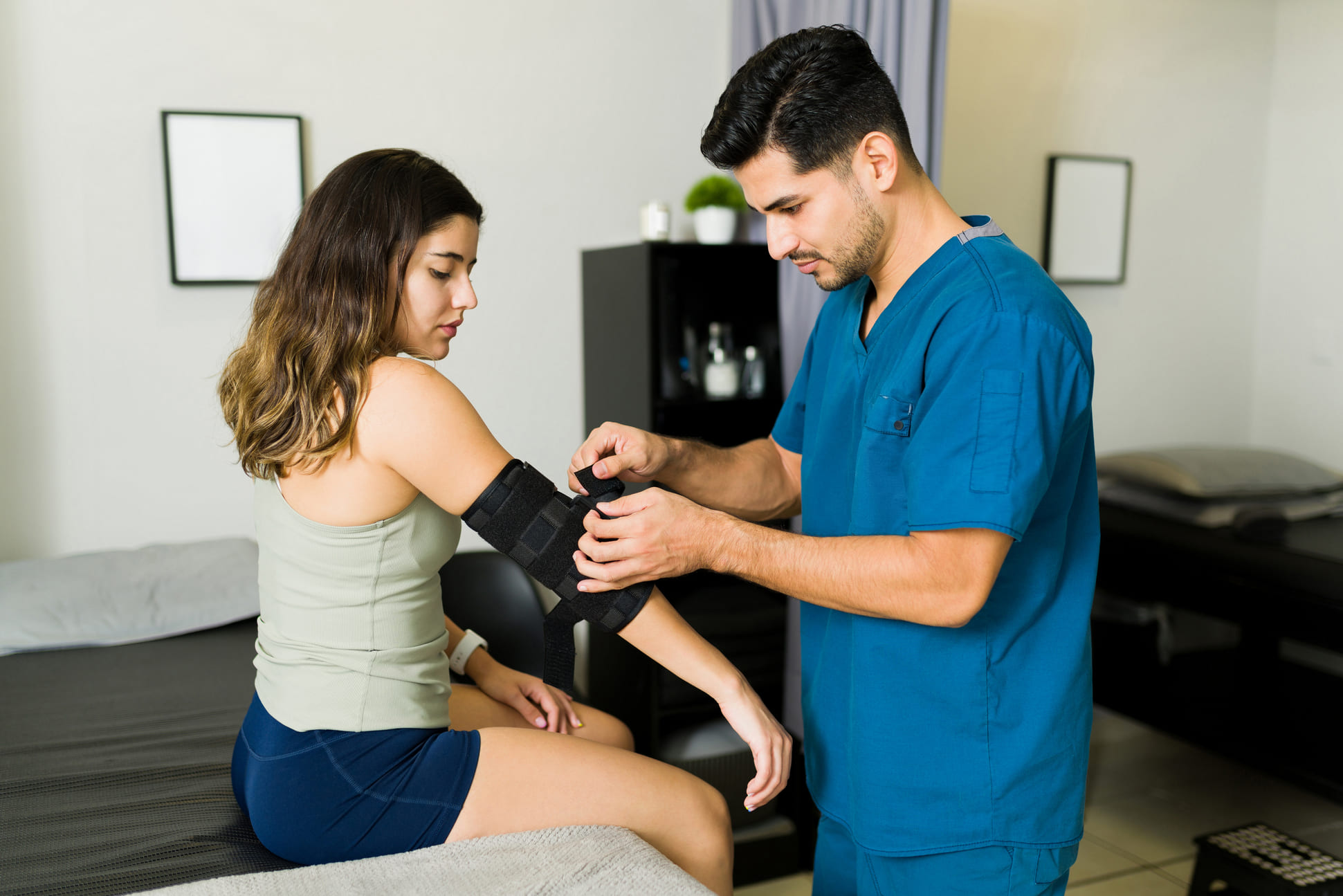
Braces are designed to provide additional support to a joint or area of the body.
Depending on the type of brace and why it’s being used, it may help improve stability, limit certain movements, reduce strain on an irritated area, or provide additional support while you return to normal activities.
Someone recovering from an ankle injury, for example, may need a very different type of support than someone dealing with recurring knee discomfort during exercise.
A brace also doesn’t necessarily replace rehabilitation.
If pain, weakness, or reduced movement is related to an injury, the longer-term goal may involve restoring strength and movement through physiotherapy while using a brace for additional support when appropriate.
There isn’t one specific point at which everyone should start wearing a brace.
Some people use one temporarily after an injury. Others need extra support during sports, work, or particular activities. A brace may also be recommended by a healthcare professional as part of a broader recovery plan.
You may consider discussing a brace or support if you are experiencing:
The reason behind your symptoms matters. A brace can provide support, but ongoing or unexplained pain should still be properly assessed.
Different parts of the body have very different movement and stability requirements. That’s why braces are designed around the specific joint or area they need to support.
Crystal Physio offers braces and supports for several areas of the body.
Your knees deal with a considerable amount of force during walking, climbing stairs, exercising, running, and many sports.
When a knee is painful or doesn’t feel as stable as usual, you may start changing the way you move without even realizing it. You might avoid putting your full weight on one leg, hesitate on stairs, or stop doing activities you normally enjoy.
A knee brace may provide additional support and stability depending on the reason for your symptoms.
Knee braces can be considered for people recovering from certain injuries, dealing with recurring knee discomfort, or looking for additional support during physical activity. The appropriate type of brace depends on what is happening with your knee and how much support is required.
Back discomfort can make lifting, standing, sitting, and even simple household tasks harder than they normally are.
A back brace or support may be useful in certain situations where additional support is needed during an activity or as part of a recovery plan.
However, a back brace isn’t automatically the answer to every case of back pain.
If you’re regularly relying on a brace just to get through your day, it may be worth assessing why the pain keeps returning. Depending on the cause, physiotherapy and appropriate exercise may be used to address movement, strength, and other factors contributing to your symptoms.
The shoulder has a large range of movement, which is useful for everything from reaching into a cupboard to throwing a ball. That mobility also means shoulder problems can affect many different everyday activities.
A shoulder support may be considered when additional stability or protection is needed.
Because shoulder pain can come from several different structures and causes, it’s important to understand what’s happening rather than choosing a support based only on where the pain is located.
An ankle can remain sore, weak, or unsteady even after the initial pain from an injury has improved.
This is particularly common after an ankle sprain. Returning to walking, running, sports, or uneven surfaces can sometimes make you realize that the ankle still doesn’t feel completely confident.
An ankle brace can provide additional stability and support during recovery or activity.
If you’ve repeatedly injured the same ankle, it’s also worth looking beyond the brace itself. Strength, balance, and movement may need to be addressed to reduce the chance of the same problem continuing.
We use our wrists constantly—typing, lifting, cooking, driving, working with tools, exercising, and even holding a phone.
When the wrist becomes irritated, those small everyday movements can suddenly become difficult to ignore.
A wrist brace can provide support and may help reduce strain during certain activities. It may also be recommended when particular wrist movements need to be limited temporarily.
The right support depends on where you’re experiencing discomfort, which movements bother you, and what you need your wrist to do throughout the day.
Elbow pain isn’t limited to athletes.
Repetitive gripping, lifting, computer work, tools, racquet sports, gym exercises, and other repeated movements can all place stress around the elbow.
An elbow support or brace may help provide additional support during work, sports, or everyday activity depending on the cause of the discomfort.
If symptoms continue despite using a support, an assessment can help determine whether there are strength, movement, or activity-related factors that also need attention.
Walk into a pharmacy or search for braces online and you’ll find dozens of options. Some are flexible sleeves, others provide much more structured support, and each is designed for a different purpose.
That’s why buying the strongest-looking brace isn’t necessarily the best approach.
When choosing a brace, consider:
Comfort matters too. A brace that doesn’t fit properly or isn’t practical for your normal activities isn’t likely to be useful for very long.
Sometimes, yes.
A brace and physiotherapy serve different purposes.
A brace may provide external support to a joint. Physiotherapy focuses more broadly on factors such as movement, strength, mobility, and function.
For example, someone recovering from an ankle injury might use a brace when returning to certain activities while also working on ankle strength and balance through physiotherapy.
Similarly, a knee brace may provide additional support, while rehabilitation addresses the underlying weakness or movement limitations associated with an injury.
At Crystal Physio, we offer physiotherapy, massage therapy, chiropractic care, and acupuncture alongside our braces and supports. When more than one type of care is appropriate, having these services available within the same Mississauga clinic can make recovery easier to coordinate.
Not everyone looking for a brace is dealing with a recent injury.
Sometimes an old problem starts bothering you again when you return to the gym. Maybe your wrist becomes uncomfortable during a repetitive task at work, or your knee feels less stable during longer walks.
In situations like these, a brace may provide additional support during the activity that’s causing difficulty.
That doesn’t mean you should simply cover up recurring pain indefinitely. If you find yourself unable to perform an activity without a brace, or your symptoms are becoming more frequent, it may be time to have the area assessed.
Understanding why the problem keeps returning can be just as important as finding something that supports it.
It’s easy to find a brace. The harder part is knowing whether you’ve chosen the right one.
At Crystal Physio, braces and supports are available within a multidisciplinary rehabilitation clinic. That means you can consider the product in the context of what you’re actually experiencing rather than treating the brace as a one-size-fits-all solution.
We offer support options for the knee, ankle, back, wrist, elbow, and shoulder, whether you’re recovering from an injury, returning to activity, or looking for additional support in everyday life.
Our clinic is located in Cooksville, Mississauga, and serves patients throughout Mississauga and surrounding GTA communities.
The right brace depends on the body area, the reason you need support, your symptoms, and what you’ll be doing while wearing it. If you’re unsure, discussing your needs with a healthcare professional can help you avoid choosing a brace that provides the wrong type of support.
A knee brace may provide support or stability for certain knee concerns, but knee pain can have many different causes. If your pain is persistent, worsening, or affecting your normal activities, an assessment can help determine what’s causing it and whether a brace is appropriate.
An ankle brace may be recommended during certain stages of recovery or when returning to activity after an ankle sprain. The amount of support you need depends on the injury and your recovery. Rehabilitation may also include exercises for strength, mobility, and balance.
Some braces are used specifically to provide additional support during physical activity. Whether you should wear one depends on the reason you’re using it and the type of activity you’re doing.
A brace needs to be secure enough to provide the intended support, but it shouldn’t cause excessive discomfort, numbness, tingling, or changes in circulation. Proper sizing and fit are important.
A brace and physiotherapy don’t necessarily serve the same purpose. A brace can provide external support, while physiotherapy may address strength, mobility, movement, and function. Depending on the problem, they may be used together.
There isn’t one timeframe that applies to every brace or injury. Some are used temporarily during recovery, while others may be worn for particular activities. Follow any instructions provided by the healthcare professional managing your condition.
Coverage depends on your extended health benefits and the type of brace. Some insurance policies may also have specific documentation or prescription requirements. Check directly with your insurance provider before purchasing if you plan to submit a claim.
If you’re recovering from an injury, returning to activity, or simply looking for additional support for a joint that’s been giving you trouble, the right brace can make a difference in how comfortably and confidently you move.
Crystal Physio offers knee braces, ankle braces, back supports, wrist braces, elbow supports, and shoulder supports in Mississauga.
Contact Crystal Physio to learn more about our braces and supports and find an option suited to your needs.
Business hours are subject to change. Please contact us to confirm the current hours before visiting.
© Copyright 2026 Crystal Physio. Website Services: Collavris
